
Email
overseas@ytsanchuan.com
-
- En
-
-

The hidden cost of water meter installation is no longer just the meter itself—it is the pipe modification, labor, and project delay that conventional meters impose when installation conditions do not match their accuracy requirements. Residential retrofits, apartment pipe duct upgrades, old-building renovation programs, and compact commercial sub-metering projects all share the same constraint: the available space dictates the pipe orientation, and the pipe orientation is rarely the horizontal, straight-run condition that many velocity-type meters need to maintain their rated accuracy.
A volumetric water meter—specifically a volumetric rotary piston water meter—solves this problem at the measurement principle level. Because it measures water by capturing a fixed volume per piston revolution rather than inferring volume from flow velocity, its accuracy is substantially independent of installation angle. Sanchuan's LXH rotary piston volumetric meter delivers Class Metrology ≤R200 in any position—horizontal, vertical, or inclined—making it the practical choice for flexible water meter installation in tight pipe ducts, vertical risers, and retrofit projects where pipe re-routing is expensive and disruptive. For utilities, contractors, and distributors managing large-scale metering programs in constrained environments, this single specification changes the installation economics of the entire project.
The installation constraint of conventional velocity meters is a structural limitation, not a quality defect. Single-jet and multi-jet meters measure the rotational speed of an impeller driven by the kinetic energy of flowing water. For this measurement to be accurate, the flow profile entering the impeller must be symmetrical and fully developed. Achieving this requires horizontal installation, minimum straight pipe lengths upstream and downstream, and freedom from nearby bends, valves, or fittings that disturb the flow. In a purpose-built metering chamber, these conditions are easy to meet. In a narrow apartment pipe duct, a vertical riser in an old building, or a compact utility room with fixed pipework, they are often impossible without significant reconstruction.
The consequence is a hidden project cost that accumulates across every constrained meter point: cutting and re-routing existing pipes, adding elbows and straight sections, extending installation time per meter, and in some cases accepting accuracy compromises that lead to under-registration and billing disputes.
A volumetric water meter removes this constraint. The rotary piston positive-displacement mechanism measures volume directly—each revolution of the piston corresponds to a precisely defined volume of water, determined by the geometry of the measuring chamber rather than by the hydraulic conditions upstream. Gravity affects the weight of the piston but not the volume it displaces per revolution. The result is a meter that maintains its rated accuracy regardless of whether it is installed horizontally, vertically, or at any intermediate angle.
The practical installation advantages for 2026 projects:
Installs accurately in compact pipe ducts without pipe re-routing
Supports vertical riser installation in old buildings without accuracy penalty
Eliminates the need for straight pipe runs upstream and downstream
Reduces installation labor per meter point in high-density residential projects
Accelerates retrofit program completion by removing the pipe modification bottleneck
Sanchuan's LXH meter specifies Class Metrology ≤R200 in any position—a direct, documentable answer to the accuracy concern that prevents many buyers from specifying vertical or non-standard installation in metering programs.
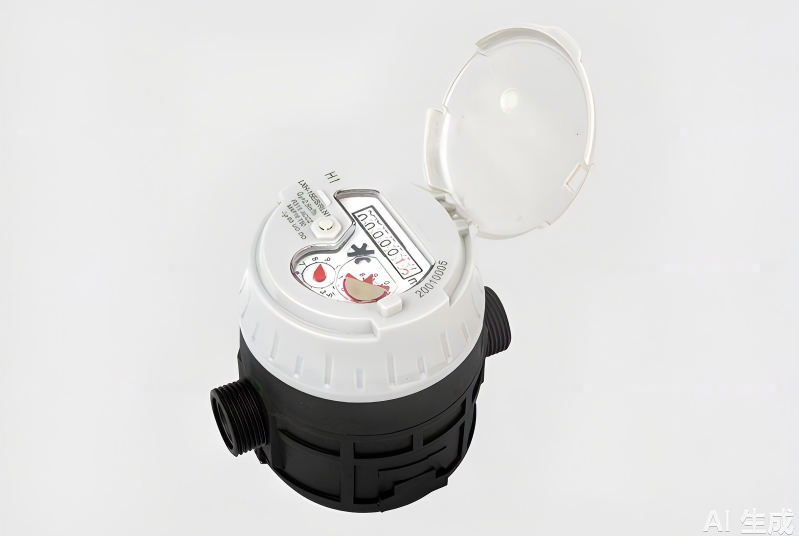
The measurement mechanism of the LXH volumetric rotary piston water meter is straightforward and robust. Water enters the measuring chamber through the inlet port. The rotary piston—a precision-machined component fitted within the cylindrical measuring chamber with controlled clearances—is displaced by the incoming water volume. Each complete rotation of the piston sweeps a fixed, precisely defined volume of water through the chamber. This volume is a function of the piston and chamber geometry alone; it does not depend on flow velocity, flow profile symmetry, or installation orientation.
The piston rotation is transferred via mechanical transmission to a sealed dry register, which totalizes the cumulative volume on 8 numeric protected rolls with an indicating range of 9,999 m³. The sealed dry-register design prevents water contact with the counting mechanism, protecting against fogging, frost damage, and contamination—failure modes that reduce register readability and increase maintenance frequency in outdoor or unheated installations.
Why this principle delivers vertical water meter accuracy:
In a velocity meter, the measuring element responds to the kinetic energy distribution of the flowing water. A non-symmetrical flow profile—caused by a bend, valve, or vertical installation where gravity redistributes the flow—produces a systematic measurement error. The magnitude of this error depends on the degree of profile distortion and the meter's sensitivity to it, and it cannot be corrected without restoring the required installation conditions.
In the LXH rotary piston meter, the measuring element responds to volume displacement. The measurement is determined by how much water physically passes through the chamber, not by how fast or in what profile it arrives. This makes the meter inherently insensitive to installation angle and upstream flow disturbance—the physical basis for the any-position accuracy specification.
Low-flow performance reinforces the billing accuracy case. The LXH-15 (DN15) is available in two configurations: Q1 = 31.25 L/h with R80 dynamic range, or Q1 = 15.625 L/h with R160 dynamic range. The LXH-20 (DN20) offers Q1 = 50 L/h (R80) or Q1 = 25 L/h (R160). These low minimum flow thresholds capture small household consumption and slow dripping leaks that fall below the starting threshold of many velocity meters—supporting accurate residential billing and providing visibility into low-level water losses.
Selecting the correct LXH configuration requires matching the specification to the installation environment, flow demand, accuracy requirement, and remote reading strategy.

Complete Technical Specification
| Parameter | LXH-15 | LXH-15 (High Sensitivity) | LXH-20 | LXH-20 (High Sensitivity) |
|---|---|---|---|---|
| Nominal diameter | DN15 | DN15 | DN20 | DN20 |
| Permanent flow Q3 | 2.5 m³/h | 2.5 m³/h | 4 m³/h | 4 m³/h |
| Minimum flow Q1 | 31.25 L/h | 15.625 L/h | 50 L/h | 25 L/h |
| Transitional flow Q2 | 50 L/h | 25 L/h | 80 L/h | 40 L/h |
| Overload flow Q4 | 3.125 m³/h | 3.125 m³/h | 5 m³/h | 5 m³/h |
| Dynamic range R | R80 | R160 | R80 | R160 |
| Overall length L | 165 mm | 165 mm | 190 mm | 190 mm |
| Width W | 90 mm | 90 mm | 90 mm | 90 mm |
General Specification
Meter body material: Brass
Accuracy class: Class 2 (ISO 4064)
Maximum water pressure: ≤1.6 MPa
Medium temperature range: 0.1°C to +30°C (cold water)
Ambient operating temperature: −5°C to +30°C
Ambient storage temperature: −5°C to +30°C
Environmental class: A (Indoors)
Indicating range: 9,999 m³ (8 numeric protected rolls)
Installation orientation: Any position (Class Metrology ≤R200)
Remote reading option: Reed switch / pulse output / remote module
Configuration Selection Guidance
For standard residential billing in apartment or house connections, DN15 with R80 (Q1 = 31.25 L/h) covers the majority of requirements. Where low-flow sensitivity is a priority—billing accuracy for low-consumption households, or leak visibility in sub-metering programs—select the R160 configuration (Q1 = 15.625 L/h for DN15). For AMR-ready projects, confirm reed switch or pulse output compatibility with the data logger or AMI platform before ordering.
Compact Apartment Pipe Ducts Modern high-density residential buildings route water supply through narrow vertical pipe ducts shared between multiple apartments. Meter installation in these ducts is constrained by duct width, pipe spacing, and access panel dimensions. The LXH meter's compact body (165 mm length, 90 mm width for DN15) and any-position accuracy allow installation in the orientation dictated by the available space—without pipe re-routing or duct modification.
Old Building Retrofit Programs Older residential and commercial buildings were constructed without dedicated metering infrastructure. Retrofitting individual apartment meters into existing vertical risers or irregular pipe layouts is one of the most labor-intensive metering project types. The LXH meter's any-position accuracy specification allows installers to work with the existing pipe layout, reducing the pipe modification scope and the associated cost per meter point. For large-scale retrofit programs covering hundreds or thousands of apartments, this saving is substantial.
Residential Billing Accuracy Upgrades Utilities upgrading from shared building meters to individual apartment metering need meters that accurately register the low flow rates typical of single-household consumption. The LXH's positive-displacement measurement and low Q1 specification support accurate billing for low-consumption households and provide visibility into small continuous flows that may indicate internal leaks or dripping fixtures—consumption that velocity meters with higher starting thresholds may miss entirely.
Commercial Sub-Metering in Compact Utility Rooms Small shops, offices, and mixed-use buildings often require sub-metering in compact utility rooms where installation space is fixed and pipe routing cannot be changed. The LXH meter's installation flexibility and stable low-flow accuracy make it a practical choice for commercial sub-metering applications where a velocity meter would require pipe modification to achieve the required accuracy class.
AMR-Ready Smart Water Projects Utilities and property managers upgrading to automated meter reading need meters with compatible pulse or remote module outputs. The LXH meter's optional reed switch and pulse output allow integration with standard AMR data loggers and AMI platforms, providing a straightforward upgrade path from manual reading to remote monitoring without replacing the meter body—protecting the initial meter investment across the smart metering transition.
Step 1 — Survey the pipe duct or installation space. Confirm available space dimensions, pipe direction, existing valve locations, and access panel size. Identify whether horizontal installation is feasible or whether vertical or inclined installation is required. For the LXH, any orientation is acceptable without accuracy penalty.
Step 2 — Select DN size and flow configuration. DN15 for standard residential connections; DN20 for higher-demand residential or small commercial connections. Select R80 for standard billing accuracy; R160 for improved low-flow sensitivity where billing accuracy at very low consumption rates is a priority.
Step 3 — Confirm pressure and temperature compatibility. Maximum water pressure ≤1.6 MPa covers standard municipal water supply. Medium temperature 0.1°C–30°C covers cold water service. Ambient operating temperature −5°C–+30°C covers indoor installations including unheated utility rooms.
Step 4 — Plan remote reading integration. Select reed switch output for connection to existing pulse-based data loggers, or confirm pulse output specification for AMI platform compatibility. For projects where remote reading is planned as a future upgrade, confirm that the meter body supports module addition without replacement.
Step 5 — Validate maintenance access. Confirm that the register can be read within the available installation space, and that the meter body can be accessed for replacement if needed. The sealed dry-register design minimizes maintenance frequency, but access planning is still important for long-term serviceability.
Lower installation labor cost is the primary TCO advantage of any-position volumetric meters in retrofit and tight-space projects. Eliminating pipe re-routing—which requires cutting, re-threading, and re-supporting existing pipework—reduces the installation time per meter point and the associated skilled labor cost. On a large apartment retrofit program covering 500–2,000 meter points, this saving per point multiplied across the full project scope typically exceeds the unit price premium of a volumetric meter over a basic velocity meter.
Faster project completion from reduced pipe modification scope allows utilities and contractors to complete metering rollouts on shorter timelines, reducing the period of unmetered consumption and improving the project's financial return.
Accurate low-flow billing from positive-displacement measurement reduces under-registration at low consumption rates. For utilities with large residential customer bases, the aggregate billing improvement from better low-flow accuracy—particularly in the R160 configuration—can recover meaningful revenue that velocity meters miss.
Sealed dry-register durability reduces maintenance interventions caused by register fogging, frost damage, or contamination. The environmental class A (indoors) rating and −5°C ambient operating temperature tolerance cover the majority of indoor residential and commercial installation environments.
Easier AMR upgrade path from reed switch or pulse output compatibility allows the meter to be integrated into remote reading infrastructure without replacement, protecting the initial meter investment and reducing the cost of the smart metering transition.
In 2026, installation flexibility is a measurable cost driver in water metering programs. A volumetric water meter with rotary piston positive-displacement measurement gives utilities, contractors, and distributors a practical solution for tight pipe ducts, vertical installation, and old-building retrofits—without sacrificing the low-flow accuracy and billing reliability that residential and commercial metering programs require. Sanchuan's LXH meter delivers Class Metrology ≤R200 in any position, Q1 as low as 15.625 L/h (DN15 R160), sealed dry-register protection, brass body durability, and optional reed switch or pulse output for AMR integration—in a compact body of 165 mm × 90 mm (DN15) that fits where other meters cannot.
Visit the Sanchuan LXH Volumetric Water Meter product page to request a recommended meter configuration and quotation.
Please submit the following details for an accurate recommendation:
Work condition: Apartment, residential retrofit, commercial sub-metering, pipe duct, indoor installation, old building renovation
Quantity: Pilot order, project quantity, or annual procurement plan
Size/spec: DN size (DN15/DN20), pipe direction, installation orientation, Q3 flow demand, R ratio requirement (R80/R160), pressure, remote reading requirement (reed switch/pulse/AMR module)
Target metrics: Any-position accuracy, low-flow sensitivity, reduced installation labor, AMR readiness, billing accuracy improvement
Current problems: Limited pipe space, vertical piping constraint, high retrofit cost, poor low-flow accuracy, manual reading difficulty, under-registration
1. What is a volumetric water meter?
A positive-displacement meter that measures water by capturing a fixed volume per piston revolution through a precision measuring chamber. Accuracy depends on chamber geometry rather than flow velocity or installation orientation. Sanchuan's LXH model delivers Class Metrology ≤R200 in any installation position, with DN15 and DN20 options for residential and commercial applications.
2. Volumetric water meter vs. velocity water meter: which is better for tight spaces and vertical installation?
For tight pipe ducts, vertical risers, and old-building retrofits, a volumetric meter is the stronger choice. Its positive-displacement measurement principle is independent of installation angle and upstream flow profile, eliminating the pipe modification required to achieve accurate velocity meter installation. Velocity meters are cost-effective in standard horizontal installations with adequate straight pipe runs, but they are less suitable where installation conditions are constrained.
3. What is the ROI of using volumetric meters in retrofit projects?
ROI comes from reduced pipe modification labor and materials, faster installation per meter point, better low-flow billing accuracy that recovers under-registered consumption, and a straightforward AMR upgrade path that protects the initial meter investment. On large apartment retrofit programs, the installation cost saving per meter point across the full project scope typically exceeds the unit price premium of a volumetric meter.
4. Does a volumetric rotary piston water meter require pipeline modification?
Significantly less than velocity meters in most retrofit scenarios. The any-position accuracy specification eliminates the need to re-route pipes to achieve horizontal installation. Buyers should confirm DN size compatibility, available installation space for the meter body dimensions (165 mm × 90 mm for DN15), pressure rating, and access for register reading or remote module connection.
5. What parameters are needed for correct selection and quotation?
DN size (DN15 or DN20), pipe orientation and available installation space, Q3 flow demand, minimum flow sensitivity target (R80 or R160), maximum water pressure, water temperature, quantity, remote reading requirement (reed switch/pulse/AMR module), and whether the project involves new installation or old-building retrofit with existing pipe constraints.