
Email
overseas@ytsanchuan.com
-
- En
-
-

For many water utilities, the difficulty is no longer simply measuring how much water passes through a customer's meter. The bigger challenge is collecting that information efficiently across thousands of connections and turning individual meter readings into useful operational data. Manual readings can provide a snapshot of consumption, but they offer limited visibility between visits and require ongoing field resources to collect.
This is where connected metering becomes valuable. An ultrasonic smart water meter can measure water consumption electronically while also communicating meter data to a remote management system. Instead of treating each meter as an isolated endpoint, utilities can incorporate consumption data into broader processes such as billing, customer service, abnormal usage monitoring, and water management.
The same principle applies at the residential level. A residential ultrasonic water meter can provide access to electronically recorded consumption information without relying entirely on a technician to read the meter on site. When the metering hardware, communication network, and utility platform are properly matched, remote meter reading becomes part of an integrated water management workflow rather than simply a replacement for manual meter reading.
The first step in remote meter reading is still accurate flow measurement. No communication system can compensate for unreliable data at the source. This is why the measurement principle of an ultrasonic smart water meter is an important part of the overall system.
Unlike a conventional mechanical meter that relies on an impeller or other moving component, an ultrasonic meter uses ultrasonic signals to determine the movement of water through the pipe. The meter evaluates how the signals travel through the flowing water and uses the measured relationship to determine flow velocity and water consumption.
Because there is no mechanical turbine rotating inside the measuring section, ultrasonic technology eliminates a major category of mechanical wear. This can be particularly useful when meters are installed in locations that are difficult to access regularly, including residential meter boxes, basements, utility rooms, or underground installations.
A residential ultrasonic water meter can electronically record accumulated consumption and, depending on its configuration, provide additional information about flow conditions, meter status, or abnormal events. The exact functions vary by product, so utilities should review the specifications of the selected model instead of assuming that every ultrasonic smart meter offers the same capabilities.
Measurement accuracy also depends on the installation itself. Air in the pipeline, unsuitable flow conditions, water quality, incorrect installation, and operation outside the meter's specified range can affect measurement performance. For a utility deployment, the meter therefore needs to be selected and installed according to the actual hydraulic conditions rather than based only on nominal pipe size.
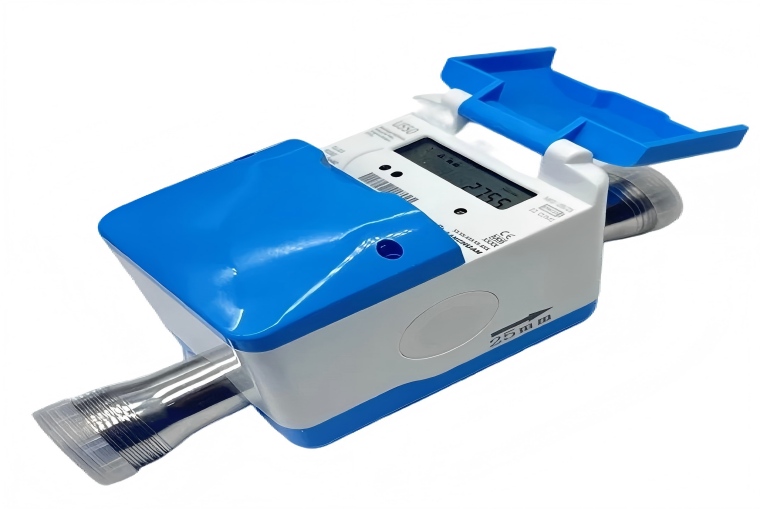
Once water consumption has been measured, the data needs to reach the people and systems that use it. This is the part of the process that turns an ordinary digital meter into a connected metering solution.
An ultrasonic smart water meter can store measurement information electronically and transmit it through an appropriate communication network. Depending on the system architecture, the data may travel directly from the meter to a central platform or pass through a gateway or other communication device before reaching the utility's management system.
Once received, the information can be organized according to meter number, customer account, location, time period, or other parameters used by the utility. This allows consumption information to become part of existing billing, monitoring, and customer-service processes.
The advantage is not simply that the utility can read the meter without sending a technician to the property. Remote transmission can also make consumption data available at a frequency that is more useful for operational analysis. Instead of having only occasional readings, the utility can work with a broader history of consumption when the system is designed to collect and retain that information.
This makes system compatibility an important consideration during procurement. The meter, communication module, gateway where applicable, and utility software all need to work together. When evaluating available solutions, utilities can review Sanchuan Water Meter's water meter product range to compare suitable metering technologies and configurations.
There is no single communication technology that works equally well for every water utility. A network that performs well in one city or residential development may not be the right choice for another project because coverage, building density, infrastructure, terrain, and existing utility systems can be very different.
Depending on the application, smart water meters may communicate through cellular networks, NB-IoT, LoRaWAN, RF-based networks, wired connections, or other low-power communication technologies. Each approach creates a different relationship between the meter, the communication infrastructure, and the utility's data platform.
Cellular communication can be practical where reliable mobile network coverage is already available. NB-IoT is designed for connected devices that require relatively low data volumes and efficient communication, while LoRaWAN can be suitable where a utility operates or has access to an appropriate low-power wide-area network. RF-based systems can use radio communication between meters and collection equipment, while wired communication may be appropriate in locations where physical network infrastructure is already available.
| Communication Technology | How It Supports Remote Reading | Important Deployment Consideration |
|---|---|---|
| Cellular | Transfers meter data through mobile network infrastructure | Coverage, operator availability, and communication service requirements |
| NB-IoT | Provides low-power cellular connectivity for connected devices | Local network availability and compatibility with the utility system |
| LoRaWAN | Connects meters through a low-power wide-area network | Gateway coverage and network architecture |
| RF communication | Uses radio signals to collect data from meters | Radio coverage, building structures, and collection network design |
| Wired communication | Transfers data through a physical connection | Installation requirements and availability of suitable infrastructure |
For residential projects, the installation environment deserves particular attention. A residential ultrasonic water meter may be installed underground, inside a building, or in an enclosed meter cabinet. Concrete walls, underground structures, and other physical obstacles can influence wireless communication. Network testing should therefore be part of project planning rather than something left until after the meters have been installed.
Remote meter reading becomes much more useful when the collected information can support more than periodic billing. The exact data available depends on the meter model and software platform, but an ultrasonic smart water meter can provide a digital record of water consumption that can be organized and analyzed remotely.
Basic information may include accumulated consumption and flow data. Depending on the configuration, the system may also provide historical consumption records, meter status, communication status, and selected alarm information. This gives utility operators more context when reviewing a particular connection.
Consumption history can also make unusual patterns easier to identify. For example, a residential connection showing persistent flow during periods when little or no consumption would normally be expected may deserve further investigation. Such a pattern does not automatically prove that a leak exists, but it gives the utility a reason to examine the account or installation more closely.
This is one of the practical advantages of a residential ultrasonic water meter. The meter can become a source of operational information rather than simply a device used to produce a periodic billing figure. Where the utility platform supports appropriate analysis, historical readings can help operators understand changes in consumption and respond to unusual conditions earlier.
Data can also be useful from the customer's perspective. When consumption information is available digitally, customer-service teams have more information available when responding to billing questions or investigating changes in water usage.
One of the most immediate benefits of remote reading is the reduction in routine fieldwork. Traditional meter reading requires personnel to visit properties or access meter locations according to a defined schedule. In large service areas, this represents a considerable operational task, particularly when meters are located in difficult-to-access areas.
With an ultrasonic smart water meter, consumption data can be collected remotely through the connected communication system. Field personnel can therefore spend less time on routine reading and more time on work that requires physical presence, such as maintenance, inspections, meter replacement, or investigation of reported problems.
Remote reading can also reduce some of the practical problems associated with manual recording. A technician may encounter an inaccessible meter, an unclear display, or a reading that needs to be manually entered into another system. Electronic data transmission reduces the number of manual steps between measurement and data processing.
Customer service can benefit from having more detailed consumption information available. When a customer questions a bill, the utility can examine the available consumption history rather than relying only on a single meter reading. Where the system provides sufficiently frequent data, changes in consumption can also be easier to understand.
For utilities with a large residential customer base, these benefits can become particularly significant. A residential ultrasonic water meter provides the measurement point, but the real operational value comes from connecting that measurement point to communication, data management, and customer-service processes.
A smart metering project should be planned as a complete system rather than as a simple meter replacement. The physical meter is only one part of the deployment. Communication, data management, installation, maintenance, and integration with existing utility systems all affect the final result.
Meter selection should begin with the actual water system. Pipe size, expected flow range, water quality, pressure conditions, installation location, and required measurement performance need to be understood before a specific ultrasonic smart water meter is selected.
Communication requirements should then be considered alongside those hydraulic conditions. If meters are installed underground or inside buildings, the available communication signal may be different from what is expected from general network coverage information. Utilities should confirm that the selected communication technology can perform reliably at the actual meter locations.
Integration is another important consideration. A smart meter may be capable of collecting and transmitting data, but the utility still needs a suitable platform to receive, store, interpret, and use that information. Billing systems, customer portals, asset management software, and water management platforms may all have different integration requirements.
Utilities should also clarify which functions are provided by the meter itself and which depend on external software. Consumption measurement, communication, alarms, data visualization, and customer-facing services may be handled by different components of the overall system.
For projects involving multiple meter types, communication methods, or residential deployment environments, discussing the requirements with the manufacturer before procurement can help prevent compatibility issues later. Sanchuan Water Meter provides a direct contact channel for discussing water metering requirements, including application conditions and product configuration.
Remote meter reading changes the role of the water meter from a device that simply records consumption into a connected source of operational data. An ultrasonic smart water meter combines ultrasonic flow measurement with digital data collection and communication, giving water utilities a way to access consumption information without depending entirely on manual meter-reading visits.
For residential applications, a residential ultrasonic water meter can provide the measurement foundation for remote consumption monitoring, abnormal usage analysis, billing support, and more responsive customer service. The effectiveness of the system, however, depends on how well the meter, communication technology, software platform, and installation environment work together.
For utilities planning a smart metering project, the most important question is therefore not simply which meter has the most functions. The better approach is to determine what data the utility needs, how frequently that data should be available, where the meters will be installed, how they will communicate, and how the information will be used after it reaches the utility platform. When those requirements are matched with the right metering technology, remote reading becomes a practical part of everyday water utility management.
An ultrasonic smart water meter measures water flow using ultrasonic signals and can transmit consumption data through a communication network for remote reading and monitoring.
It electronically measures and records water consumption and sends the data through a suitable communication network to a utility platform, where authorized users can access and analyze the information.
Depending on the project, smart water meters can use cellular networks, NB-IoT, LoRaWAN, RF communication, wired connections, or other suitable communication technologies.
Depending on the model and connected platform, it may provide consumption data, flow information, historical readings, meter status, communication status, and selected alarm information.
It can provide consumption or flow data that reveals unusual usage patterns. However, an unusual pattern should be investigated rather than automatically treated as proof of a leak.
Utilities should consider measurement requirements, pipe and water conditions, installation environment, communication coverage, platform compatibility, data requirements, maintenance, and integration with existing utility systems.