
Email
overseas@ytsanchuan.com
-
- En
-
-

When a water pipeline reaches a large diameter, selecting the right flow meter becomes a practical engineering decision rather than a simple product comparison. The meter has to work reliably across the system's normal flow range, fit the available installation space, limit unnecessary pressure loss, and remain manageable over years of operation. These requirements are especially important in municipal distribution, irrigation, industrial water supply, and other bulk water applications where a small measurement issue can affect a large volume of water.
Two technologies are commonly considered for these systems: the Woltman water meter and the ultrasonic meter. A Woltman meter relies on a mechanical turbine to measure flow velocity, while an ultrasonic meter determines flow from ultrasonic signals passing through the water. Both can be used for large-diameter pipelines, but their operating principles lead to meaningful differences in installation, pressure loss, maintenance, and application suitability. Understanding those differences makes it easier to choose a meter based on actual system conditions rather than simply comparing specifications on a datasheet.
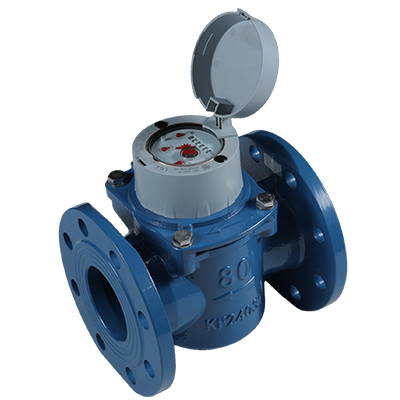
A woltman water meter is a velocity-based mechanical meter. As water passes through the meter body, it drives an internal turbine or impeller. The rotational movement is transferred to the register or measurement mechanism, allowing the meter to determine the volume of water passing through the pipeline.
This approach has been used extensively for large-volume water measurement because the principle is relatively straightforward and well established. A properly selected bulk type water meter can therefore be used in applications such as municipal water distribution, irrigation networks, industrial water supply, and commercial water systems.
Ultrasonic meters use a different principle. Instead of placing a rotating measuring element in the water stream, they transmit ultrasonic signals through the pipe and use changes in signal travel time to determine water velocity. Some designs use multiple measurement paths to obtain a more representative reading across the pipe.
The difference is important in practice. The Woltman design depends on mechanical movement, while ultrasonic measurement is based on electronic sensing. Neither principle is automatically suitable for every installation. The right choice depends on flow conditions, water quality, hydraulic requirements, and the operating environment in which the meter will be installed.
Large-diameter pipelines rarely operate at exactly one flow rate. Demand can change throughout the day, seasons can affect water consumption, and industrial processes may create significant differences between minimum and peak flow. For this reason, the usable flow range is often more important than the maximum flow value printed on a product specification sheet.
A Woltman water meter is well suited to applications with substantial and relatively predictable water flow. Its mechanical measuring element provides a direct relationship between water movement and the meter's reading. However, its actual measurement performance depends on factors such as meter size, internal design, flow rate, accuracy class, and the condition of the water.
Ultrasonic meters can be attractive where flow conditions change considerably. Because they do not depend on a mechanical turbine starting and rotating, they can provide useful measurement performance across a broad operating range when properly specified and installed.
That does not mean an ultrasonic meter is automatically more accurate than a Woltman meter. Measurement performance should always be evaluated using the manufacturer's specified flow range and accuracy data for the particular model. For a bulk type water meter, the critical point is whether the selected meter can maintain the required performance at the system's minimum, normal, and maximum operating conditions.
| Comparison Factor | Woltman Water Meter | Ultrasonic Meter |
|---|---|---|
| Measurement principle | Mechanical turbine or impeller | Ultrasonic signal measurement |
| Large-diameter applications | Commonly used for bulk water measurement | Suitable for large pipeline flow measurement |
| Moving measuring parts | Yes | No mechanical moving parts in the measuring section |
| Variable flow conditions | Depends on the specified operating range | Can be suitable for applications with changing flow |
| Pressure loss | Depends on internal turbine design and flow rate | Generally very low for full-bore designs |
| Maintenance | Mechanical components require attention over time | Less mechanical wear, but electronic components still require inspection |
| Typical use | Municipal, irrigation, commercial and industrial bulk water | Municipal, industrial and process flow measurement |
Even a technically capable meter can produce disappointing results if the pipeline layout is unsuitable. Installation conditions should therefore be considered at the same time as meter selection.
For a Woltman meter, the pipeline should remain properly filled during normal measurement, and the meter needs to be installed in the specified flow direction. The surrounding pipework should also provide appropriate hydraulic conditions. In systems where the water contains sediment or other suspended particles, filtration and water quality deserve particular attention because contaminants can affect the mechanical measuring components over time.
Ultrasonic meters also depend on suitable hydraulic conditions. Depending on the design, upstream and downstream straight-pipe requirements may apply. Elbows, valves, pumps, reducers, turbulence, air bubbles, or partially filled pipes can influence the flow profile and consequently affect measurement stability.
The installation environment matters just as much as the meter itself. A meter positioned immediately downstream of a pump or close to several flow disturbances may experience conditions very different from those assumed during laboratory testing.
For this reason, engineers should check the manufacturer's installation instructions before finalizing the pipeline arrangement. When comparing different meter options, reviewing the available water meter products from Sanchuan can also help clarify which designs are intended for particular pipe sizes and operating conditions.
Pressure loss becomes increasingly relevant as water systems grow larger and operate continuously. Every restriction in the flow path contributes to hydraulic resistance, which can influence pumping requirements and overall operating efficiency.
A Woltman water meter contains a turbine or impeller inside the flow path. Water must pass around and through this mechanical measuring element, so some pressure loss is inevitable. The actual value depends on the meter's internal structure, nominal size, and operating flow rate and should be taken from the manufacturer's technical documentation.
Ultrasonic meters approach the problem differently. Since the measurement is based on ultrasonic signals rather than a rotating turbine, a full-bore ultrasonic meter can have very little obstruction in the water passage. This can make the technology attractive for systems where maintaining hydraulic efficiency is particularly important.
For a high-flow pipeline operating around the clock, pressure loss should not be treated as a minor specification. A small difference at the meter can become more meaningful when multiplied by continuous operation over a long service period.
At the same time, pressure loss is only one part of the purchasing decision. The acquisition cost, installation requirements, maintenance arrangements, water quality, expected service conditions, and required measurement performance should all be considered when evaluating a bulk type water meter.
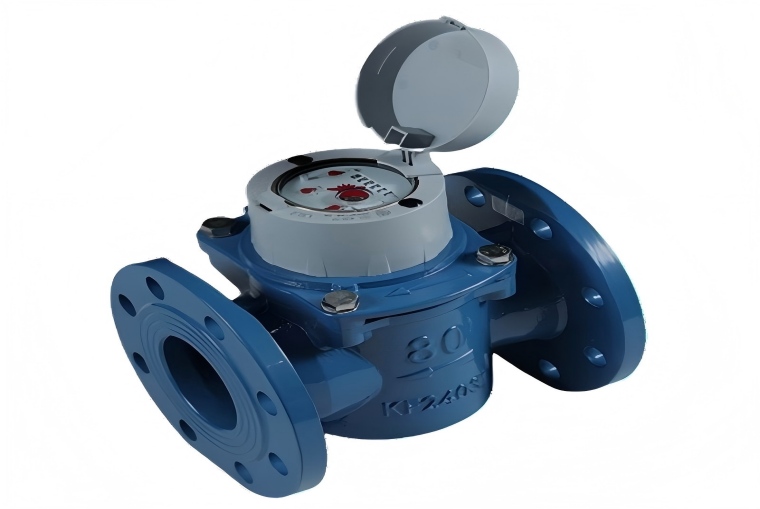
The mechanical nature of a Woltman meter means that its internal components are exposed to the water being measured. Over time, wear, deposits, suspended solids, and changes in water quality can affect the condition of the turbine and other mechanical parts.
This does not make Woltman meters unsuitable for demanding applications. In fact, their established construction is one reason they continue to be used for bulk water measurement. The important point is that maintenance should reflect the actual water conditions and operating environment rather than assuming that every installation will have the same service requirements.
Ultrasonic meters remove the rotating mechanical element from the measurement process. This reduces concerns related specifically to turbine wear, but it does not eliminate maintenance altogether. Sensors, electronics, connections, communication interfaces, and the physical installation still need to remain in good condition.
Verification is also important for both technologies. Where measurement is used for billing, water-loss analysis, process control, or other applications where accuracy has financial or operational consequences, inspection and calibration should follow the relevant project requirements and manufacturer's recommendations.
A Woltman meter is often a practical option when the system requires a proven mechanical solution for measuring substantial water volumes. Municipal distribution networks, irrigation systems, commercial water supplies, and industrial facilities can all make use of this type of meter when the operating conditions match its specifications.
For a conventional bulk water application with stable hydraulic conditions, a woltman water meter can provide a straightforward measurement solution without the additional electronic complexity associated with some ultrasonic systems. It can also be a familiar choice for operators who already have experience maintaining mechanical water meters.
Ultrasonic meters become particularly relevant when low pressure loss, minimal mechanical wear, digital measurement functions, or changing flow conditions are important considerations. They can also be attractive in installations where access for mechanical maintenance is difficult.
Consider a municipal pipeline supplying several distribution zones. If the flow is relatively stable and the operator already has an established maintenance process for mechanical meters, a Woltman solution may fit naturally into the existing system. In another installation where flow changes substantially and minimizing hydraulic resistance is a priority, an ultrasonic meter may be considered instead.
The decision should therefore begin with the actual pipeline rather than the technology name. Pipe diameter, expected flow range, water quality, pressure conditions, installation layout, communication requirements, and maintenance access all contribute to the final specification.
For projects where these factors need to be assessed together, Sanchuan Water Meter can review the application requirements and help identify suitable options. Buyers can contact Sanchuan Water Meter for application-specific guidance and provide details such as pipe size, expected flow, water conditions, and installation environment.
Woltman and ultrasonic meters solve the same basic problem—measuring water flow—but they approach it in very different ways. A Woltman water meter uses a mechanical turbine and has a long history in bulk water applications, while an ultrasonic meter uses electronic measurement without a rotating element in the flow path.
For buyers selecting a bulk type water meter, the most useful comparison is not simply Woltman versus ultrasonic. The more important question is how each technology performs under the actual conditions of the pipeline. Flow range, water quality, pressure loss, installation space, maintenance access, communication requirements, and long-term operating expectations should all be considered before a final specification is made.
When these factors are matched carefully to the meter design, both technologies can provide a reliable solution for large-diameter water systems. The goal is to select the measurement principle that fits the hydraulic system, operating environment, and service requirements—not simply the technology that appears most attractive on paper.
A Woltman water meter is a mechanical velocity-based water meter that uses an internal turbine or impeller to measure water flow. It is commonly used for larger pipe sizes and bulk water applications.
Yes. Woltman meters are widely used for large-diameter water pipelines and bulk water measurement, provided the meter size and flow range are correctly matched to the application.
A Woltman meter measures flow through the movement of a mechanical turbine, while an ultrasonic meter determines flow using ultrasonic signals and has no mechanical turbine in the measuring section.
Many full-bore ultrasonic meters have very low pressure loss because there is no rotating turbine obstructing the flow. The actual pressure-loss performance should be checked against the manufacturer's specifications.
A Woltman meter has mechanical components that can be affected by wear and water quality. Ultrasonic meters have fewer mechanical wear components, although their sensors, electronics, and connections still require appropriate inspection.
Consider pipe diameter, minimum and maximum flow, normal operating flow, water quality, pressure conditions, installation layout, communication requirements, and maintenance expectations. These factors provide a better basis for selecting a meter than pipe diameter alone.